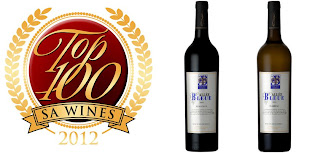
Decanter is an up market magazine on wine and spirits, published in over 90 countries on a monthly basis. The magazine content includes news from the industry, vintage guides and wine recommendations. Decanter organizes the annual Decanter World Wine Awards. Visit Decanter Wikipedia
Wine South Africa & vintage: Shiraz 2010
Origin: Franschhoek
Label: Allée Bleue
Farm location: R45 Franschhoek Valley
Wine maker: Van Zyl Du Toit
Grape varieties: Shiraz
Style of wine: Barrel matured red wine
Vinification: Fermented in tank with temperatures peaking at 28°C.
Extended skin contact was done for 10 days after fermentation
Wood maturation: 70% New French oak with the rest 2nd and 3rd fill barrels.
10% was AWO
Winemaker’s
notes: Intense deep red colour. A powerful bouquet of violets, spice
and chocolate. The pallet is smooth and silky packed with berry fruit
and spice nuances.
Analysis: Alcohol 14.8% vol
Residual Sugar 3.6 gm/l
Total Acidity 6.1gm/l
pH 3.4
Food
paring: Ostrich kebabs basted with red currant jelly and freshly ground
pink peppercorns and finished with a Shiraz reduction. Medallions of
Springbok rubbed with cumin and flash roasted – served with spiced
beetroot.
Wine South Africa makes an incredibly wide variety of wines from a number of different grapes. As we've talked about in other parts of the site and our blogs we believe at Uncorked Ventures that some of the best International wines come right from our own backyard.
Luckily for wine drinkers South Africa produces two such grapes, that are both highly unusual:
Pinotage and Chenin Blanc (Post will follow on this amazing Chenin grape varietal)
Pinotage; Pinotage is a cross between Pinot Noir (a cold weather grape) and a French varietal that most a unfamiliar with, Cinsaut (a warm weather grape). Perhaps no other varietal in the world is as unique as Pinotage, as it seems growers in effect tried to create a grape that would grow perfectly in their unique climate. Pinotage also sometimes gives winemakers fits during the fermentation process, turning bad and being bottled only to yield a smell similar to paint. Your guess is as good as ours at this point about the future of Pinotage, but at Uncorked Ventures we certainly hope that worldwide winemakers are able to have more unique grapes and varietals, not less. Personally, I'd love to find a good producer of Pinotage, just for the conversation that it would create with friends and family. It is on my to-do list at present time.
Dark chocolate and plums are the first things you encounter in the perfume, which prepare you for the delights to come. Despite its elegant body, there's depth, richness and intensity here that tells you there's a serious base under the eminent drinkability. It's a balanced wine, nothing's out of place, all the elements work in harmony, which is why it is so appealing. On the other hand, Pinotage is famous for its ageing ability, and this one's pliable oak component makes it a worthy canditate for the further cellaring.
Want more wine information? Want to join a real interactive wine that is interested in more then just taking your money for their real business? Use promo code on Facebook to take 10% off your Allée Bleue Wine Estate fan order just for reading this article!
The care and maintenance of your grape vineyard is vital to the long term health of your vines, and ensures that they will continue to produce quality grapes for your South African wine - winemaking. Pruning grapes is the process that will ensure the best quality grapes and subsequently the best tasting South African wine possible.
Pruning is simply the process of removing unwanted parts of the plant to ensure that the goals we established for our vineyard are met. By pruning we can control the size and form of the vines, control the size and quality of grape production, and maintain a balance between vegetation and fruit.
Only new growth will produce grapes, so it is important that healthy new canes are produced each year. New growth may be held back if pruning is delayed during the dormant season. You want to plan your pruning to ensure that it is started early enough so that the entire vineyard is pruned properly and on time. Late pruning may cause the occurrence of harmless "bleeding". This modification helps in maintaining the vine's vigor and sufficient fruiting wood. Crop production is affected by either deficiency or excess of good fruiting wood.
What would happen if you didn't prune? Good question. You have probably experienced this in other areas of your garden. If you didn't take the time to prune your apple tree for example, the following year there were more apples on the tree than you could eat but they probably were not as sweet or as ripe. If grape vines are left un-pruned they will produce a bumper crop, however, the quality will significantly suffer. By producing so much fruit the vines do not have the energy to bring the grapes to the ripening stage...lots of grapes of poor quality is the result of neglecting vineyard pruning.
In fact, the purpose of pruning grapes is to remove as much as 95% o 98% of the previous year growth. This ensures that the balance of the vineyard is maintained between the correct amount of vegetation and the correct amount of fruit, and ensures the energy of the plant is funneled back into producing healthy, quality grapes for the following year.
It should be evident that pruning grapes is vital to the production of quality grapes. It takes quality grapes to make a quality wine of South Africa, so it goes that pruning directly affects the wine quality we are able to produce. This process will ensure the health of the vineyard and subsequently the best tasting wine possible.
After aging on the lees for the
past 22 months , the day has finally arrived to degorge our new Methode Cap Classique (MCC). A blend of
Pinot Noir and Chardonnay wine of South Africa warrants the extra time on the lees. The wine has been
slowly cooling down in our walk-in fridge since last week. So this morning it
was “ bombs away”. The wine is kept upside down ever since the riddling was
done. This process is called remuage and is when we turn die bottles in special
racks to move the yeast to the mouth or neck of the bottle. Bottles are then
placed in the ice bath ( running at -25 ° C) and the wine and yeast is frozen
to the neck. The bottles are place in the degorging unit. This will first move
the bottle to a 45 degree angle, flip off the crown cap, then pressure (from
the secondary or bottle fermentation) shoots out the icicle with the yeast
trapped inside. Viola, the wine is clean. Then the same machine adds a small
amount of dosage, a blend of old wine, sugar and some sulphur. Then on to
the corking and wiring unit where the cork and wire is then applied. Then
a quick wash and back into the bins. Until we get the labels and finish of the wines of South Africa..
Keep your eyes and ears open for
the release in our Tasting Room. You won’t be disappointed.
Allee Bleue is known to be one of the oldest yet most characteristic wine farms in the Cape. This wine estate has an eventful past, yet it has the ‘it’ factor when it comes to being one of the undiscovered jewels of the Cape Winelands.
This estate boasts picturesque scenery ranging from the majestic Drakenstein mountain range, vineyards and lavender with age old meadows. When visiting the farm, you will immediately experience an unmistakable French vibrancy, seeing that it is after all on the door step of Franschhoek's historic town, which is South Africa’s own taste of France.
When this dynamic husband and wife team bought the farm, Friedrich-Wilhelm and Elke Dauphin, made very important investments. These two investments are the ingredients for a winning recipe! They employed staff and built a state of the art cellar for the production of award winning wines!
Tasting
Allow yourself the pleasure of experiencing wine of South Africa tasting in a way that only Allee Bleue can offer. Savour the beautiful bouquets of our wines as well as a taste of our olives and olive oil.
In our tasting room you have the opportunity to taste world class wines, poured by our knowledgeable & helpful team of staff. Let Allee Bleue set the bar for your tasting room experiences in South Africa!
Pre-booked cellar tours are conducted on a daily bases, so you can see where this fabulous wine is born.
Light lunches are served in the courtyard, as well as in the bistro. Food for everyone's taste!
Tour groups exceeding 10 people need to pre-book, in order to avoid disappointment.
Children must please be accompanied by their parents. feel free to contact us at wine.tasting@alleebleue.com
We have recently started with the Labeling of the Allee Bleue 2012 Harvest, very exciting! Things are in full swing with the Sauvignon Blanc 2012, Starlette Blanc 2012 and
Starlette Rose 2012, we can expect it to be on shelves across the globe soon.
But how do you remove the Allee Bleue label from your South African wine?
Removing the label from an Allée Bleue bottle of wine may seem like an every
day occurrence; surely people everywhere have their reasons for scraping
fingernails against a square of paper. Perhaps some people remove the
label to make a wine collage. Perhaps some people remove one to fill up
an empty space in their scrapbook. Perhaps some people even remove it to
compose a ransom note entirely out of wine tags. But, most likely,
people simply remove wine of South Africa labels so they can collect them. Whether
these labels are taken off to collect memorabilia or taken off to
collect ransoms, one things stands in between the label and the bottle:
adhesive. Yes, this substance can leave you in a bit of a sticky
situation.
Removing an Allee Bleue wine label may seem easy enough; you simply
peel and pull. But, that peeling and pulling can often lead to ripping
and tearing, something that ruins the quality of the label and defeats
the purpose of preserving it. Instead, taking some time to learn that
removing what's outside is almost as much of an art form as drinking
what's inside can be the difference between a label worth keeping and
one worth throwing in the trash. Below are few of the ways to not label
yourself frustrated when trying to tug off the tag.
[Allee Bleue can not be held responsible in any way for any action taken with regards of the use of these Tips]. .
Adhesive Tape:
The use of adhesive tape may seem like a bit of a conundrum; after all,
it's the adhesive that is the problem to begin with. But, using tape to
pull off the label actually works well. You can purchase this kind of
tape from a wine magazine, or you can simply make you own. All this
process involves is placing a large piece of clear tape against the
wine's label and pulling it off. This won't remove the entire label, as
the layer of the label with glue on it will remain adhered to the
bottle, but it will take off the part of the label that is worth saving. Pros: Relatively simply to do, time saving, and leaves your wine label with a "laminated look" as a plastic film covers it. Cons:
If you purchase via a wine magazine, this process can be a bit pricey.
You may also prefer a wine label without the "laminated look." If that's
the case, this avenue is not for you.
Blow Dryer: Blow
dryers aren't just for hair anymore; they are also for wine bottles.
Using one of these appliances can help melt the glue that is keeping the
label adhered to the wine bottle. Once this glue is melted, the label
should come off with relative ease. Pros: This process is
cost free for those who already own a blow dryer. Not only this, but
your wine bottle will surely have that silky, manageable, no-frizz look
afterwards. Cons: The air from a blow dryer might not be
hot enough to cause the glue to reach its melting point. If this is the
case, the label will not peel off easily and may rip as it's being
pulled.
Hot Water Method: Using heat on the inside to
remove the label on the outside is a method that some people have found
successful. The first step in this, naturally, is to make sure the wine
bottle is completely empty; we don't want any drops going to waste. The
next step involves filling the bottle with hot water and allowing this
water to sit until the edges of the label start to come up, as if
holding their arms up in surrender. Grabbing the surrendering arms of
the label and gently tugging should be enough to get the label
completely off. Pros: As long as you have a hot water faucet, this is a highly affordable procedure. It is also laden with simplicity. Cons:
The bottle may be too thick for the hot water to really influence the
label and convince it to come off. The label may also be too hard to
peel or only parts of it may refuse to come off.
Soaking in Water:
When in doubt, soak. Simply placing the bottle in a sink full of hot
water and adding a few drops of dishwasher detergent may be all you need
to remove a label, even a stubborn one insisting on staying put. If the
label doesn't simply come off, it will at least come loose, allowing
you to edge along it with a razor blade or putty knife. Pros:
This seems to be the most successful method of label removal,
particularly for labels that are European as several of these generally
use a less sticky adhesive. Cons: Soaking the bottle in
water that is too hot can cause the label to discolor and using more
than two or three drops of detergent can cause the label to wrinkle and
wilt. Additionally, using razors or knives to edge along the label can
be dangerous, particularly when wine is involved.
Soaking in Gasoline:
Yes, some people actually suggest the method of soaking the bottle of
wine of South Africa in gasoline for ten minutes and waiting for the label to simply
fall off. Because hey, if alcohol and gasoline aren't a good combo, then
we don't know what is. Pros: You can put your fire insurance to use. Cons:
You may blow yourself up, or perhaps worse, your entire wine cellar. If
water doesn't do the trick, forego the gasoline and instead try soaking
the bottle overnight in a wall-paper removal solution.
Wine label removal can be a bit tricky, but with a little trial and error, you
should be able to find a method that works well for you, at least most
of the time. If nothing seems to aid removal, and all else fails, simply
do away with collecting wine labels: just collect Allee Bleue wine bottles instead.